
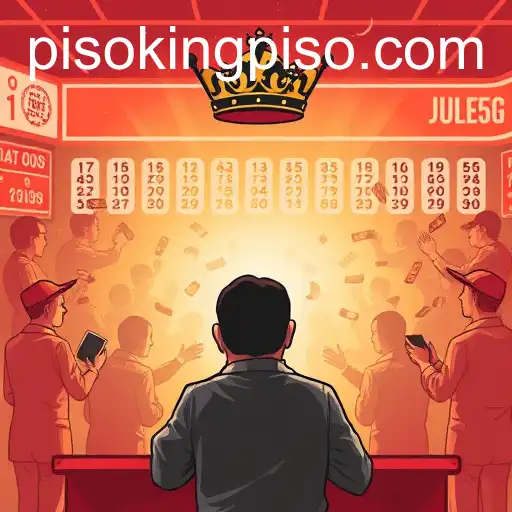
PISO KING | Jueteng and the Rise of the PISO KING Phenomenon
PISO KING’s Examining jueteng in the Philippines with a focus on the PISO KING figure, embodying the interplay of gambling, economy, and politics.
Jueteng and the Rise of the PISO KING Phenomenon
In the realm of illegal gambling in the Philippines, jueteng has been a prominent subject of discussion for decades. Known for its deep roots in local communities, jueteng presents a challenge for law enforcement and governance. At the center of this narrative is the emergence of the so-called "PISO KING," a term that has recently gained prominence in both media and public discourse.
Understanding Jueteng
Jueteng is a numbers game of chance that thrives mainly in the provinces of the Philippines. Though it is outlawed, this form of gambling persists due to cultural engrainment and the strong social ties that underpin its operations. The game is simple to understand yet complex in its organization. Participants wager on a set of numbers from 1 to 37, drawn twice daily. Despite its illegality, jueteng is highly popular and is sometimes considered a staple part of community life.
The game's illegal status does not deter its prevalence. Instead, it has evolved over time, adapting in response to law enforcement efforts and political climates. These adaptations have made the operation and perpetuation of jueteng a point of contention between law enforcement and civic society.
The Role of the PISO KING
In the narrative of jueteng, the term "PISO KING" has emerged as a modern representation of influential figures within the gambling scene. Although historically, jueteng operations were run by a close-knit circle of local conspirators, the term PISO KING signifies an evolution in control.
Who is the PISO KING?
The PISO KING is often characterized as a mysterious and powerful individual who holds significant control over jueteng operations. Their influence extends beyond gambling into political and economic spheres, suggesting a complex network of power and money.
The emergence of the PISO KING speaks volumes about not only the resistance of jueteng to eradication efforts but also its institutionalization within certain regions. This figure encapsulates both the allure and the danger of jueteng - its capacity to corrupt and integrate into the very fabric of local governance.
Economic Impacts
The perpetuation of jueteng and the rise of entities like the PISO KING hold significant economic implications. For the average citizen, jueteng offers the allure of quick money, promising returns on minor investments – a peso, hence the moniker. For operators, the returns can be monumental.
However, these returns come at a societal cost. Money funneled into jueteng operations is money that could otherwise be spent on legitimate economic activities. Local economies suffer as a result, with funds bypassing economic infrastructure that supports community development and improvement.
Jueteng's Social Dynamic
The game of jueteng is deeply interwoven with the social fabric of many Filipino communities. It provides informal networks of support for struggling families, becoming part and parcel of daily life. However, the game's illegality and the rise of personalities like the PISO KING lead to deeper societal issues, not least of which is the entrenchment of corruption.
For local communities, the normalization of illegal gambling can lead to a skewed sense of legality. The open secret of jueteng fosters an environment where legal boundaries blur, and justice becomes selective. This phenomenon contributes to a normalization of illegality that spans beyond gambling, touching upon other areas of law and order.
Law Enforcement Challenges
Efforts to combat jueteng have met with limited success. Law enforcement agencies are often stymied by the secretive nature of the operations and the lack of resources to effectively dismantle such a deeply embedded network. The PISO KING and associates can exert significant influence, making it difficult for justice to be served.
Furthermore, allegations of corruption within law enforcement itself further complicate the issue. In some cases, regulatory and policing efforts are undermined by systemic issues where those supposed to eliminate the problem are themselves beneficiaries of illicit activities.
Political Dimensions
The political landscape surrounding jueteng and the PISO KING is fraught with complexity. Politicians can exploit the game for electoral gains, providing below-the-table endorsements that secure votes in exchange for turning a blind eye to illicit activities. As such, jueteng transcends being merely a gambling issue, becoming a matter of political strategy and maneuvering.
The PISO KING, along with their network, can lobby for their interests in subtle yet impactful ways. The repercussions of such political engagements are vast, impacting local governance and public trust in political institutions.
Future Prospects
The future of jueteng and individuals such as the PISO KING remains uncertain. Despite ongoing efforts to curtail its prevalence, the game endures due to its deep entrenchment within both the socio-political and economic landscapes of affected regions.
Ultimately, any attempts to address the issue must be multifaceted, combining stringent law enforcement with socio-economic interventions, mindful regulatory frameworks, and community engagement. Only then can the Philippines hope to break the enduring cycle that both jueteng and figures like the PISO KING represent.
